 Marvel's long-awaited indie anthology is finally happening.
Tasty.
(via The Beat)
British writer JG Ballard died on the weekend. He was one of the great twentieth century writers of science/speculative fiction.
One famous quote dubbed him as a great surreallist writer and his insight into the psychological effects of modernity was profound, never pretentious or overwrought. His writing is very beautiful.
Read The Guardian's obituary, Ballard in his own words, an appreciation of Ballard's influence on just about everything and some other articles on him.

Paul Grist is certainly best known for his self-published ground-breaking police-procedural, Kane, and for his homage to the superhero genre, Jack Staff. With his new comic, The Eternal Warrior, Grist brings his minimalist graphic style online. OK Erok conducted a Q&A with Paul about how his visual style has developed.
Your layout seems very spacious compared to conventional comics layout. For example, there are only three ‘panels’ in some of your Eternal Warrior (and Kane) pages. You've said before that you were influenced by Frank Miller's Daredevil, in terms of storytelling and structure. Can you elaborate on this and your 'philosophy' of storytelling?
“The storytelling in The Eternal Warrior is different to what I've done in previous comics (Kane and Jack Staff), where I've tended to use the page as a single unit. With Eternal Warrior I'm trying to speed up the production process and I'm using double pages as a single unit, so what I might have got on a single page previously, is spread over two. This gives more space to the layouts.
 What I'm doing is trying to get away from a traditional approach to the comic page - so not using the usual panel boxes, but trying to let the pictures define the shape and layout on the page. It's a different way of working - and I think a different way of reading - to what I've done before, which I think is in keeping with the type of story I’m telling.
I'm trying to do something that is very much a comic, where words and visuals work together. The page with the silhouette and the legend of Leonard - which is not something I've really done before - will be the approach I take for The Eternal Warrior. It's a different to what I'm doing with Jack Staff, which is different to what I did with Kane.”
In looking at contemporary comics, your work is very distinctive. Do you consider yourself a stylist, in any sense? How do you place style, in terms of importance? Do you think there any kinds of comics that you could not/would not adapt to?
“Each story needs a different approach. I think my ‘style’ is distinctive, without being the same regardless of the story. I'm trying to work my way through different story genres - humour, crime, superhero and now fantasy (for want of a better word) - eventually I'll find something I'm good at!”
Do you undergo a long creative gestation period before you start work or do you feel your way into a story as you write/draw it? How did the idea for the Eternal Warrior come about?
“I have had the idea of doing a Big Cosmic Comic rolling round my head for a while now. I did some pages, left them for a few weeks, then came back and redid them - basically I was just running on the spot! - but posting the pages forces me to move forward.”
In terms of your process, as a cartoonist, you seem to place emphasis on speed. Why is this? Has your process changed - or do you see it changing (through technological or any other means) - so that you can work faster? Can you describe your creative process from a to z, in terms of composing pages and pacing stories?
“The speed thing is just a discipline - ideally I would like to be doing something like The Eternal Warrior as a bimonthly companion title to Jack Staff - but I need to prove to myself that I can do it.”
The composition/pacing, as well as the writing, is all done on the page - it's all part of the same thing, after all - which I think is the best way to go for a writer/artist. I don't write a script which I then draw - as the artist I wouldn't want to tie myself down like that.
Usually I start with an idea - perhaps an image or a scene - which I then draw/script. As I work I think how about how this scenario could develop and a story evolves. One way to describe it would be ‘organic’; another way would be ‘chaotic!’
Working like this led to occasions (on Kane and Jack Staff) when what I thought was going to be the beginning of a story became the end, so I worked backwards to reach my starting point! The Eternal Warrior is more linear than Jack Staff and Kane - so I’m not that disorganised, yet! - but I'm only seven pages into it. There's plenty of time!
It works for me, but I wouldn't advise it for anyone else.”
How do you feel about self-publishing nowadays? Do you see it as a necessary evil or a creative choice? The advent of print-on-demand and the internet have lowered the barrier to self-publishing. And there seems to be a natural flow from webcomics to paperback collections. Do you see yourself publishing an Eternal Warrior trade paperback, for example, at the end of its run or will you seek a publisher for it? Have you come across any self-published comics in recent years that have really impressed you?
“I do plan on printing The Eternal Warrior at some point - either as a back-up strip in Jack Staff or as a comic in it's own right - but the facebook group/blog is more an exercise to get me to actually finish pages, rather than coming back to them periodically and starting over!
The internet and print-on-demand allow you to get your work seen, but to make money from it you have to work with the comics distribution set up. The distribution system, for all its faults, allows people to publish their own work and (because it is based on firm sales) know before printing how much (if any) money they will make, so it's a fairly low risk financial proposition.
I don't think self-publishing is as easy as it was a few years ago - there are more hoops to jump through with Diamond - but I still see it as a viable option to being published by a 'proper' publisher.
Favourite self-published titles at the moment are Glamourpuss by Dave Sim and Rasl by Jeff Smith, but they're not the newest kids on the block!”
 The death of their mentor reunites a fractious group of estranged superheroes for a new challenge.
Few comics in recent years have attracted so much critical excitement and popular adoration as The Umbrella Academy. Undoubtedly, one reason for this is that it is written by Gerard Way, lead singer of rock group My Chemical Romance.
Way is by no means a dilletante, idly turning his hand to a quaint medium. Before rock called, Way went to art school, aiming to work in comics and produced original artwork for the series; he has since gone on to write on Spiderman and other comics titles and The Umbrella Academy is now into its second series.
Brazilian artist Gabriel Ba was draughted in to illustrate The Umbrella Academy. His line work is reminiscent of Duncan Fegredo's work on Hellboy, angular, clean and simple, but never terse or mechanical, thanks to its hand-drawn style.
Ba shares with Fegredo the good fortune to have his work coloured by Dave Stewart (who coloured Fegredo's art in Hellboy: The Wild Hunt). Stewart's colouring looks like overlaid cutouts of craft paper in muted tones, with occasional bright hues (as above). The result is textured, atmospheric and stunning.
The story concerns a seven orphaned mutants raised to be a super team, by the eccentric and steely Sir Reginald Hargreeves. Years later, long since estranged from one another, they gather for Hargreeves's funeral, and before long sibling tensions surface. Before long they are saving the world.
The Umbrella Academy is quirky without being affected or mannered. It does not break genres, and it recalls many other comics, but (in its emphasis on family dynamics and emotional relationships) there is a tenderness to its storytelling. This is not to say there is not plenty of action and adventure, but here is a rare example of a comic which - like a great superhero team - is greater than the sum of its parts.
 I could kick myself for missing the BBC 4 documentary, In Search of Steve Ditko, which aired last autumn.
I am currently reading a Marvel Pocket Book which collects Ditko's early Dr. Strange stories and explains how the brilliant surgeon, Steven Strange, became the even more brilliant occultist.
Dr. Strange is quite unlike any other Marvel comic. With its edgy, abstract graphics and dark themes, it's easy to see how it attracted a counter-culture following in the 1960s.
Fantagraphics recently published a critical retrospective of Ditko's work, Strange and Stranger, and there seems to be renewed interest not only in his seminal role on Spiderman and Dr. Strange, but his later (weirder) work for DC and Charlton Comics.
Apart from his great, though unusual, creative talent, the mystery about Ditko's abrupt departure from Marvel Comics and Spiderman, his reclusive character and his adherence to Ayn Rand's quasi-fascist ideology, Objectivism, all contribute to the enigma that is Steve Ditko.
There are only snippets of the BBC documentary around YouTube, so I am grateful that fellow comics enthusiast Doug Pratt has posted the full program in decent quality, in six seven-eight minute segments (1, 2, 3, 4, 5, 6 and 7). Thanks Doug!
BBC 4 is currently rerunning its Comics Britannia documentary series. The first program, about DC Thompson's Comics Factory - which created Beano, The Dandy, Whizzer and Chips etc - was excellent and I look forward to the next installment.
[via Paul]
 Just read this interesting interview with Ridley Scott, from last October's Wired, in which he talks about the influence of Blade Runner on design and particularly architecture.
I think of Ridley Scott as a kind of cinematic designer - dispassionate, cool, technical (he came from an advertising background) - and that seems justified by many of his early films.
Syd Mead was the concept designer and 'visual futurist' who created a lot of the famous vehicles and street scenes for Blade Runner, Aliens and many other films and computer games.
 Mead is more or less credited with inventing contemporary concept design and influencing everybody from Katsuhiro Otomo (Akira) to, well, everybody. For example, Imagine FX did a big feature about Syd Mead last month, with workshops about how to create a Mead/ Blade Runner-esque scene in Photoshop and so on.
Of the aesthetic in Blade Runner, Mead has said:
"We called the whole look 'retro deco.' What I did in my imagination was to mash together every architectural style I could think of. So, I violated architectural motif, and it's funny because architects love that film. Maybe it's cathartic for them."
"Because it's a wholly fabricated world, and the typical thing to do would have been to give it one style. Again, the point is, when you go into the future, you don't start from zero, you take everything along with you. You have to have old stuff to overlay the new stuff. And that's part of what gives "Blade Runner" it's unusual look."
While I love Mead's drawing, with its profuse detail and interest - and his Blade Runner paintings, which evoke the atmosphere evident in the film - most of his gouache painting is pretty awful; lurid, 1960s, Sci-Fi confectionary, full of bubble furniture and naked people wandering about (as you do in the future).
Although Mead's Blade Runner design is exceptional, it has also been given exceptional prominence in his work.
 I have been alerted to the excellent artwork of Rick Froberg, an American musician and artist/ illustrator.
Froberg works in a variety styles - all displaying his strong graphic sensibilities and beautiful draughts- manship - which seem at least partly inspired by cartooning/ illustration (and perhaps) tatoo art from the 1950s.

Froberg recently illustrated the cover for Irish band The Dudley Corporation's 2008 album, Year of the Husband.
[Via Conor]
 Rob Liefield is a comics creator and publisher who engenders mixed feelings in the comics world. On one hand, he is respected as an entrepreneur - despite acrimonious relationships with most of his commercial partners - on the other he is seen as an obnoxious creep.
 Lots of spleen, in particular, has been vented about Liefield's poor drawing skills, as evident above (and many other places). However, plenty of comics illustrators, with less commercial and greater artistic sensibilities than Liefield, are not brilliant draughtsmen. They are not pilloried and nor should they be.
Rob Liefield had great success with Marvel Comics and Image Comics (which he co-founded) and I feel that something about the way he is viewed typifies a kind of schizoid self-loathing at the heart of comics culture.
It seems intolerable to some people that Liefield can be a commercial success without being a creative one. Liefield himself has readily admitted that he was in the right place at the right time:
"I'll be the first to tell you that we [the Image collective] were never the best artists. We were never the best at anything, but just like a song or a band or whatever, we caught on and we toured rigorously." [Wizard Magazine via Wikipedia]
Liefield sees comics not as a cultural medium (like Scott McCloud or perhaps Alan Moore), but as a sector of the publishing industry, which hires 'talent' and produces 'product'. Both are true. There is a publishing sector which caters to teenaged boys. It may be critically derided, but it is a commercial 'fact on the ground.'
Perhaps Liefield represents a stereotype of comics as juvenile, power fantasies (or indeed of comics creators as juvenile fantasists), that is embarrassing. Perhaps it reminds many of us that we once shared those fantasies, that secretly we still do or that those fantasies reflect the larger fantasies of modern capitalist culture.
In any case there are bigger fish to fry than Rob Liefield.
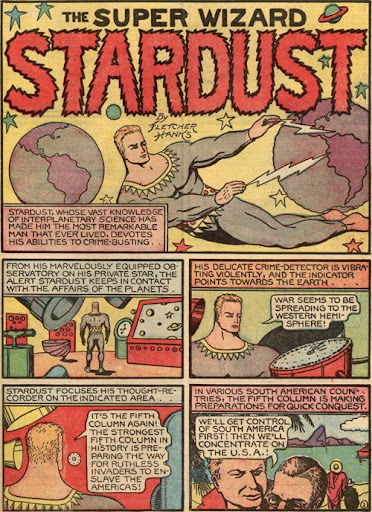 Little is known about Golden Age comics artist Fletcher Hanks, but that he made some very weird comics. Hanks is probably known for the unintentional humour in his exclamatory captions and impassive, sociopathic heroes, but that tells only half the story.
Hanks allied his crude storytelling to powerful, eerie images, with a strong graphic sense in titles such as...
"'Tabu, Wizard of the Jungle', 'Fantomah Mystery Woman of the Jungle', the lumberjack hero 'Big Red McLane', and the cosmic superheroes 'Stardust, The Super Wizard' and 'Space Smith', which appeared in Fantastic Comics from Fox Publications in 1940. Little is known about the artist's fate since he left the comics field in the early 1940s."
Hanks's stories litter the internet (such as the six Stardust strips here), but Fantagraphics recently published a collection of Hanks's comics, edited by Paul Karasik, entitled I shall destroy all the civilised planets. There's an interesting review at Lady, That's My Skull.
 Remi George, better known as Hergé - the creator of Tintin - is 101 today. Today a huge worldwide industry has grown up around Tintin - spawning shops and merchandise and countless books and a long-anticipated film adaptation by Steven Spielberg - but, says comic critic Paul Gravett:
 'Hergé - the Belgian-born father of Tintin - remains a figure who inspires devotion, controversy and, most of all, mystery.'
Gravett's article is very interesting, as are the commentaries from Chris Ware and Micheal Faber.
 Congratulations to Bob Byrne, talented illustrator and comix writer/artist, who has been nominated for two Eagle Awards, one of the top awards that recognise comic artists!
Good news for Bob, who has been plugging away diligently (if scatologically!) for many years, and is one of very few world class comics artists in Ireland. Hopefully this provides some inspiration for wannabe comics writers/artists out there. Oh, and if you like his work and care for comics, please vote for Bob.
While voting for Bob on the Eagle website, I also discovered a couple of great online comics.
Although I've always thought the prospect of online comics was interesting (since I read Scott McCloud's Understanding Comics), I've found that quality of artwork is an entry barrier. Being hot for good illustration, I am delighted to endorse Dr. McNinja and particularly Girl Genius.
 Ha! The title of this post sounds like a pulp adventure novel!
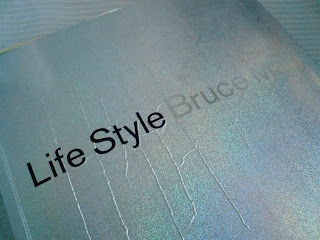
This Saturday, in the course of a mammoth shopping trip - the kind I never do - I went into Chapters book shop and bought Bruce Mau's Life Style. Although I am a biblophile (bordering on biblioholic) I did trade in about six old books - half the price of the new book - which, incidentally, was on sale. Woo!
Anyway...
During some random research I had read Bruce Mau's incomplete manifesto for growth and been impressed. It's published in Life Style, along with a lot of other interesting thoughts and images from Bruce Mau Design. Here's a taste of the manifesto, but I strongly recommend reading the whole thing:"1. Allow events to change you.
You have to be willing to grow. Growth is different from something that happens to you. You produce it. You live it. The prerequisites for growth: the openness to experience events and the willingness to be changed by them.
2. Forget about good.
Good is a known quantity. Good is what we all agree on. Growth is not necessarily good. Growth is an exploration of unlit recesses that may or may not yield to our research. As long as you stick to good you'll never have real growth.
3. Process is more important than outcome.
When the outcome drives the process we will only ever go to where we've already been. If process drives outcome we may not know where we’re going, but we will know we want to be there.
4. Love your experiments (as you would an ugly child).
Joy is the engine of growth. Exploit the liberty in casting your work as beautiful experiments, iterations, attempts, trials, and errors. Take the long view and allow yourself the fun of failure every day.
5. Go deep.
The deeper you go the more likely you will discover something of value.
6. Capture accidents.
The wrong answer is the right answer in search of a different question. Collect wrong answers as part of the process. Ask different questions.
7. Study.
A studio is a place of study. Use the necessity of production as an excuse to study. Everyone will benefit.
8. Drift.
Allow yourself to wander aimlessly. Explore adjacencies. Lack judgment. Postpone criticism.
9. Begin anywhere.
John Cage tells us that not knowing where to begin is a common form of paralysis. His advice: begin anywhere.
10. Everyone is a leader.
Growth happens. Whenever it does, allow it to emerge. Learn to follow when it makes sense. Let anyone lead."
There is a point to this anecdote. Coming across the book seemed to be one of those happy coincidences when the Universe fulfils a deep wish. Firstly, seeing the "process is more important than outcome" point above - which has recently become my unofficial motto - sort of reminded me that I'm on the right track.
After seeing You and I and Everyone We Know, I developed a strong creative crush on Miranda July. I stopped short of stalking her in person or even via the internet, but like all such crushes, I had the intense feeling that we should be friends and that we are kindred spirits. Imagine my intense delight to learn that she had published a book of short stories.
I think that that is the effect that all really good art has. Or should have. A feeling of kinship with it maker. Maybe not accompanied with maniacal obsession to find out everything about its maker. (I'm not in love with you, Miranda. I just like you!) Art is about communicating, right?
Miranda July strikes me as the kind of person who should be an artist. Honest, loving and with a strong desire to see beauty, even in ugly places and ordinary people.
When I was younger, I was full of optimism about the transformative potential of art. I studied Art History at college. I thought that everybody should make art, drink coffee and smoke cigarettes. I met a lot of hip, shallow people. Then I became cynical. I realised that most contemporary Art was more about getting ahead in the Art scene than self-expression, and more concerned with patronising 'ordinary' people than communicating with them. I gave up coffee and cigarettes. I gave up on art. Then I realised that being a scenester is not a prerequisite for making art any more than it is for appreciating it. All either requires is an open mind and an open heart.
Like Miranda July.


 Michael Kupperman's blog - appropriately subtitled 'here comes madness' - is well worth a look-see.
  What I'm doing is trying to get away from a traditional approach to the comic page - so not using the usual panel boxes, but trying to let the pictures define the shape and layout on the page. It's a different way of working - and I think a different way of reading - to what I've done before, which I think is in keeping with the type of story I’m telling.
 Paul Grist (self-publisher and creator of Kane and Jack Staff), one of my very favourite comics creators, is posting a new web-comic! It's called The Eternal Warrior (I think!) and looks amazing!
 I recently posted a lovely picture of a Samurai/ Archer putting on battle dress, but erroneously attributed it to Paul Pope, on whose blog I had seen it. Whew!
 Mead is more or less credited with inventing contemporary concept design and influencing everybody from Katsuhiro Otomo (Akira) to, well, everybody. For example, Imagine FX did a big feature about Syd Mead last month, with workshops about how to create a Mead/ Blade Runner-esque scene in Photoshop and so on.
 Rob Liefield is a comics creator and publisher who engenders mixed feelings in the comics world. On one hand, he is respected as an entrepreneur - despite acrimonious relationships with most of his commercial partners - on the other he is seen as an obnoxious creep.
 Little is known about Golden Age comics artist Fletcher Hanks, but that he made some very weird comics. Hanks is probably known for the unintentional humour in his exclamatory captions and impassive, sociopathic heroes, but that tells only half the story.
 Ha! The title of this post sounds like a pulp adventure novel!
  Secondly, in the course of some current research into the gift economy, I have been wanting to find my copy of George Bataille's The Accursed Share. As soon as I looked for it, it showed up, peeking out of a pile of books.
 Naturally, I opened Life Style to find that Bruce Mau had designed the book.