 Lovely little how-to by Sarah McIntyre (Vern and Lettuce and formerly of The DFC) for the Cartoon Museum in London.
Showing posts with label Making comics. Show all posts
Showing posts with label Making comics. Show all posts
01 April, 2009
Sarah McIntyre shows how it's done
Lovely little how-to by Sarah McIntyre (Vern and Lettuce and formerly of The DFC) for the Cartoon Museum in London. 

26 March, 2009
Keep working
Patience is a virtue. Practice makes perfect. Hardly popular modern sentiments.
Shaenon Garrity writes a very encouraging article relating the premise of Malcolm Gladwell's Outliers - that it takes 10,000 hours of concentrated practice (about 10 years) to master a skill, in any field - to the world of comics.
Shaenon Garrity writes a very encouraging article relating the premise of Malcolm Gladwell's Outliers - that it takes 10,000 hours of concentrated practice (about 10 years) to master a skill, in any field - to the world of comics.
"I started drawing comics regularly, really working at it, in 2000. If Malcolm Gladwell is right, I'll have a chance at drawing really good comics starting sometime next year. That's something to look forward to. Start now, and you can have something to look forward to, too."It turns out that many greats of comics took at least this long to reach their peaks. We all need something to look forward to, hope that our endeavours (creative or otherwise) will be worthwhile. In the meantime, be patient, keep working.
12 March, 2009
Alison Bechdel on Making Comics
A really interesting short video in which Alison Bechdel talks about her process in creating Fun Home.
(via Drawn via Mike Lynch)
25 February, 2009
Dave Sim's Glamourpuss
Here's a really interesting video documenting Dave Sim's (of Cerebus fame) laborious process of drawing Glamourpuss. Try to ignore Sim's creepy voiceover.
02 February, 2009
Famous Artists Cartoon Course
"It's a bad idea to try to prevent people from knowing their own history. If you want to do anything new you must first make sure you know what people have tried before."
- Ernst Gombrich, A Little History of the World
I've posted all the available lessons from The Famous Artists Cartoon Course up on Issuu. Whether or not you are interested in learning to draw, the lessons are illustrated by such old-school heroes as Al Capp and Milton Caniff.
(via Comicrazys and Leo Brodie)
29 January, 2009
Review: Comics 101: How-To & History Lessons from the Pros!
A short primer that places cultural context at the heart of comics creation
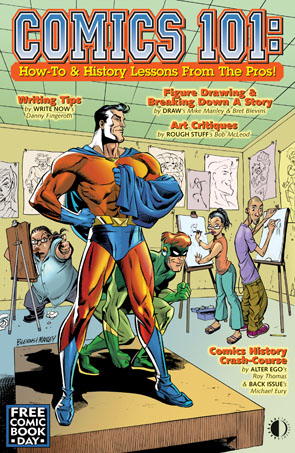 Most manuals and ‘how-to’ books about making comics fall into three categories: the first assumes no drawing skill on the reader’s part and instructs accordingly; the second assumes some skill in drawing (and using software) and offers technical direction about combining or adding to those skills; the third, and most useful, considers comics holistically, as a cultural medium.
Comics 101 falls into this third category. Really an extended magazine, produced by by TwoMorrows Publishing for Free Comic Book Day 2007, Comics 101... features articles by editors from several of its specialist comics-related magazines.
So firstly, there are articles on figure drawing and story layout, which cut to the point very smartly.
I also found Bob McLeod’s critique of a Fantastic Four layout fascinating and full of direct advice (‘It’s always better to design your elements using diagonals, rather than horizontals and verticals’ and ‘center the figures in the panel, then design the backgrounds around them’ and so on).
The article on writing is fairly general, but offers some good points on etiquette in dealing with publishers. But the two longest articles are potted histories of comics. The first article explains the roots of the comics medium up to the 1970s and the evolution of the super-hero genre. The second article concerns the modern era of comics, the advent of commercialisation and direct sales and the innovation of indie comics and the graphic novel.
What marks Comics 101 out as unusual is its insistence on basic skills, patient development of ideas and awareness of the historical and cultural context in which comics are created and consumed.
Of course it cannot be as in-depth as Scott McCloud's Making Comics, at just 30-odd pages, but as a freebie it is excellent value in every way.
Most manuals and ‘how-to’ books about making comics fall into three categories: the first assumes no drawing skill on the reader’s part and instructs accordingly; the second assumes some skill in drawing (and using software) and offers technical direction about combining or adding to those skills; the third, and most useful, considers comics holistically, as a cultural medium. Comics 101 falls into this third category. Really an extended magazine, produced by by TwoMorrows Publishing for Free Comic Book Day 2007, Comics 101... features articles by editors from several of its specialist comics-related magazines.
So firstly, there are articles on figure drawing and story layout, which cut to the point very smartly.
I also found Bob McLeod’s critique of a Fantastic Four layout fascinating and full of direct advice (‘It’s always better to design your elements using diagonals, rather than horizontals and verticals’ and ‘center the figures in the panel, then design the backgrounds around them’ and so on).
The article on writing is fairly general, but offers some good points on etiquette in dealing with publishers. But the two longest articles are potted histories of comics. The first article explains the roots of the comics medium up to the 1970s and the evolution of the super-hero genre. The second article concerns the modern era of comics, the advent of commercialisation and direct sales and the innovation of indie comics and the graphic novel.
What marks Comics 101 out as unusual is its insistence on basic skills, patient development of ideas and awareness of the historical and cultural context in which comics are created and consumed.
Of course it cannot be as in-depth as Scott McCloud's Making Comics, at just 30-odd pages, but as a freebie it is excellent value in every way.
12 January, 2009
Cartooning v Illustration
Is it necessary to be a good draughtsman to be a good cartoonist? I’m not sure. Graphic style (pen, brush, digital and stroke) and draughtsmanship (perspective technique and design) effect storytelling in Comics in a way that is unique to the medium.
I believe that concept and plot are related by observation of realistic drawing rules (ie. perspective, depth cues and foreshortening); emotion and character by expressive line (and/or colour) (ie. emanatae, abstract visual elements).
 In the little treatise-cum- instruction supplement to the last issue of Comic Art, Cartooning: Philosophy and Practice, Ivan Brunetti says that the minimum job of cartooning is to convey the visual characteristics necessary for us to recognise drawings as symbols.
Brunetti illustrates - see what I did there? - with an exercise in which one draws several everyday subjects (a car, a cat, a castle, yourself) a number of times, in successively shorter periods (2 minutes, 1 minute, 30 seconds, etc.), forcing one to strip down images to their essential elements.
As Brunetti says:
Jessica Abel and Matt Madden seem to agree. The first exercise they set in Drawing Words & Writing Pictures suggests that one tries drawing stick men. I think cartooning owes a lot more to the discipline of design than is commonly acknowledged and that, in many senses, comics stand or fall on this strength.
Is it necessary to be a good draughtsman to be a good cartoonist? No, it's not necessary, but to be a good cartoonist without being a good draughtsman requires exceptional storytelling. A reasonable storyteller with strong drawing skills is unlimited in terms of storytelling. Lots of amateur cartoonists fail because they want to tell stories beyond their drawing ability.
It’s perfectly valid to criticise comics on the basis of their art; perhaps it is the most valid basis for criticism. As Dez Skinn writes in the introduction to Comic Art Now, comics are and have always been about the artwork.
I believe that concept and plot are related by observation of realistic drawing rules (ie. perspective, depth cues and foreshortening); emotion and character by expressive line (and/or colour) (ie. emanatae, abstract visual elements).
In the little treatise-cum- instruction supplement to the last issue of Comic Art, Cartooning: Philosophy and Practice, Ivan Brunetti says that the minimum job of cartooning is to convey the visual characteristics necessary for us to recognise drawings as symbols. Brunetti illustrates - see what I did there? - with an exercise in which one draws several everyday subjects (a car, a cat, a castle, yourself) a number of times, in successively shorter periods (2 minutes, 1 minute, 30 seconds, etc.), forcing one to strip down images to their essential elements.
As Brunetti says:
“...When we really have too little time to ‘think’ about the drawing we get closer to the ‘idea’ or essence of the thing being drawn. Here we begin to see the universal, latent, symbolic, visual, mnemonic language that is comics.”Brunetti argues that the goal of cartooning is to reach a compromise between the drawing that satisfies its fictional requirements to occupy space in the visual world of the comic and its function as a symbolic element of the story (ie. the drawing must ‘feel’ physically solid and be ‘readable’ as a symbol).
Jessica Abel and Matt Madden seem to agree. The first exercise they set in Drawing Words & Writing Pictures suggests that one tries drawing stick men. I think cartooning owes a lot more to the discipline of design than is commonly acknowledged and that, in many senses, comics stand or fall on this strength.
Is it necessary to be a good draughtsman to be a good cartoonist? No, it's not necessary, but to be a good cartoonist without being a good draughtsman requires exceptional storytelling. A reasonable storyteller with strong drawing skills is unlimited in terms of storytelling. Lots of amateur cartoonists fail because they want to tell stories beyond their drawing ability.
It’s perfectly valid to criticise comics on the basis of their art; perhaps it is the most valid basis for criticism. As Dez Skinn writes in the introduction to Comic Art Now, comics are and have always been about the artwork.
15 December, 2008
F*** pens (not really)
I’m always interested in how people go about producing comics. It’s instructive about the craft and fascinating from a creative perspective. For example, Paddy Brown (who writes and illustrates The Cattle Raid of Cooley web-comic) dives right in with a pen.
Regular readers of this blog will know that I like to draw. I’m okay at it, but I lack a bit of confidence. However, I have discovered something interesting about my process of ideation (at least visually).
Given a pen, I often hesitate to make my first mark and if it is not a good one, I lose heart. With a pencil it’s a different story. (And it’s not because I can erase as I draw; I often don’t bother).
I feel much more relaxed with a pencil (and not a push-pen either, a good old piece of wood with a rod of graphite down the middle). The tactile qualities of the pencil reassure me that nothing bad is going to happen. The feel of the wood in my fingers, the contact of the rounded graphite point on the paper, the natural quality of the line (its colour and shape) comfort me.
It seems that the tactile qualities of the pencil do not appeal to Paddy, who gives a full description of his unique comics production process:
Regular readers of this blog will know that I like to draw. I’m okay at it, but I lack a bit of confidence. However, I have discovered something interesting about my process of ideation (at least visually).
Given a pen, I often hesitate to make my first mark and if it is not a good one, I lose heart. With a pencil it’s a different story. (And it’s not because I can erase as I draw; I often don’t bother).
I feel much more relaxed with a pencil (and not a push-pen either, a good old piece of wood with a rod of graphite down the middle). The tactile qualities of the pencil reassure me that nothing bad is going to happen. The feel of the wood in my fingers, the contact of the rounded graphite point on the paper, the natural quality of the line (its colour and shape) comfort me.
It seems that the tactile qualities of the pencil do not appeal to Paddy, who gives a full description of his unique comics production process:
“I don't use pencils - I find working directly in ink more satisfying. When I work with a pencil I find myself becoming more tentative, second-guessing myself, and when I've got a pencilled drawing I'm happy with, inking kills it. So I cut out the middle man.”As long as we're all drawing.
Subscribe to:
Posts (Atom)