Showing posts with label Review. Show all posts

05 June, 2009

Review: Terminator: Salvation


Like
Ridley Scott's Alien, James Cameron's
Terminator featured a striking score, gut wrenching tension and a dynamic cast. Like Alien, Terminator maintained a sort of cult status until Cameron blew them up with big budget sequels. From atmospheric origins, both developed big franchises. But while the Aliens films have devolved into schlock (as anyone who has seen Alien V Predator can atest), the Terminator films have been far better up to now.

The Terminator films have stuck to their original premise: in the near future, a computerised defence network - Skynet - becomes self-aware and wages total war on humans. Identifying John Connor (future leader of the human resistence) as the one threat to its dominance, Skynet sends a cyborg hitman back from the future to nip it in the bud.

Terminator: Salvation breaks continuity with previous films in many ways. And while the recent Star Trek showed that it is possible to take new directions and remain faithful to the spirit of a film's history, Salvation does neither.

The film takes place in 2018, during humankind's guerilla warfare against the machines. John Connor is a prominent military leader, whose regular radio broadcasts inspire the scattered pockets of human resistence.

The plot effectively concerns Connor's attempt to rescue human prisoners - and one in particular - from a Skynet prison camp, although there are plenty of diversions, theatrics and ornamentations along the way. In fact, there are three storylines, none of which mesh comfortably, and despite its almost two hour running time, it is thin on story.

Salvation bears all the trademarks of Hollywood 'development', mashing disparate elements together to tick the boxes of what market research focus groups predict will sell. It is chock full of fanboy references to the style of the first two iconic Terminator films, without retaining any of the substance of those films's success.

The absence of Arnold Schwarzenegger, who utterly embodied the role of the implacable Terminator, hangs over Salvation like a pall. Christian Bale, as John Connor, is the stand-out performer, but his characteristic 'intensity' is wasted on a thin role among many thinner ones.

It is worth bearing in mind that Salvation's director, McG, is a journeyman director, whose previous credits include Charlie's Angels, TV show Fastlane and music videos for pop group The Pussycat Dolls. In short he is steeped in shit.

The relentlessness of the machine hunter and the courage and resilience of its human prey gave The Terminator and Judgement Day a kind of mythic depth, beyond the emotional thrills. In Salvation 'grit' is a visual style, but the fear of extermination and personal doom is absent.

13 May, 2009

Review: Wolverine and Star Trek

Two film franchises expanded this month.

X-Men Origins: Wolverine is a prequel/spin-off to the X-Men films (which themselves tie into the larger
Marvel Universe, as we're sure to see on screen in due course). Star Trek is also prequel of sorts, grafting onto the trunk of the Star Trek mythos.

How did Wolverine become Wolverine? X-Men Origins: Wolverine
, presuming this is a question worth answering, follows the relationship and rivalry between mutant half-brothers, James Logan and Victor Creed, via their involvement with evil government scientist William Stryker. Their divergent paths - Logan's towards a normal life and Creed's towards violence and savagery - lead them to become Wolverine and Sabretooth, respectively.

The wild success of the X-Men franchise was due, in no small part, to Bryan Singer's witty direction of the first two episodes. Similarly, the Spiderman films and the recent Iron Man, benefitted from the strong authorial stamps of Sam Raimi and Jon Favreau respectively. The producers of Wolverine tried the same route, hiring Gavin Hood (Tsotsi and Rendition) to direct.

The action sequences are competent, but much of the characterisation is flat and uninteresting, with a consequential tonelessness across the piece. Like the disappointing X-Men 3, Wolverine feels functional, formulaic and indifferent to its material. The character of Wolverine is shorn of much of ambivalence, mystery and vulnerability that made him interesting in the first two X-Men films. And none of the supporting characters are well developed.

Of course Hugh Jackman is fine and veteran character actor Liev Schreiber puts in a menacing performance as Creed, but the plot is convoluted, trite and obscure by turns and serves mainly to service future additions to the Marvel franchise.

By contrast Star Trek is a veritable love letter from director JJ Abrams (of Lost
fame) to Gene Roddenberry's original Star Trek series, while remaining accessible to the non-Trekkie. It is also a masterclass on the space opera genre, without resorting to the kind of clichés that tebesmirch : cool spaceships, mind-boggling special effects, fascinating characters, strange worlds and creatures, a love triangle, a diabolical world-ending machine, time travel, near-misses and last-minute escapes.

The plot sees a villainous Romulan, Nero (played with earthy vigour by Eric Bana), seeking revenge in kind for the destruction of his homeworld. Can the crew of the USS Enterprise stop him? In so far as this is as straightforward adventure movie, it is Kirk's story, but the emotional core of the movie is with commander Spock - vulnerable, brilliant and arrogant - caught between his human and vulcan heritages and desires, freedom and belonging.

Successive directors of Star Trek films came to realise that the relationship between Spock (intellectual and emotional) and Kirk (physical and instinctual) was the key to its success, but few have interrogated it so subtly, and sparks fly between Quinto's Spock and Pine's Kirk. To do this while keeping the jumping and fighting in focus is all the more satisfying. This is not so much a revision, as a revisitation, of Star Trek's roots.

JJ Abrams has mastered the pace of an action film. Star Trek, like Abrams Mission Impossible 3, veritably sprints along. In fact, like Wolverine, Star Trek is replete with characters and incident, but never gratuitously. And if it can be a bit breathless at times, Star Trek is never boring and how often can you say that of a 2 hour movie?

20 February, 2009

Review: Give Me Liberty

A young woman survives deprivation, war and political machinations in this bleak and charmless work.

‘Black humour’ must be among the most over-used, mis-represented descriptions of creative failure; usually it is heavy on the blackness and low on humour. ‘Political satire’ falls into the same category and few works have the political insight to justify the claim.

The comics industry owes Frank Miller a debt of gratitude. Miller's noir stamp on Daredevil and then Batman, in the 1980s, breathed fresh air into stale franchises and ushered in a new ‘gritty’ era of comics.

DC published Miller’s Batman: The Dark Knight Returns in 1986, the same year as Watchmen. Liberating and fresh, these works seemed to demonstrate the potential of the comics medium to express adult ideas and stories. Unfortunately, the industry's vogue for ‘dark’ and ‘mature’ themes led them to fill their comics with gratuitous violence, cynicism and exploitative misogyny.

These qualities, always nascent in Miller's stories, came to dominate them. Miller's work never again hit the heights of Dark Knight and has increasingly come to parody itself.

Set in a dystopian near future, Give Me Liberty follows the adventures of Martha Washington, a black girl from a violent Chicago slum, who joins the US army and
becomes a war hero. Martha's story provides a through-line for the degeneration of the US government and the internal political struggles.

Give Me Liberty is replete with gags.
For example, Martha takes her name (presumably) from George Washington's wife. The US Army is renamed PAX - latin for 'peace' - ironically recalling the Pax Romana, the 'Roman Peace', a period of relative tranquility during the time of the Roman Empire.

There is no shortage of ideas - the title comes from Patrick Henry's famous insurrectionary quote 'Give me liberty or give me Death!' - but quite what Miller wants us to take from them, beyond the obvious 'irony' is unclear.

And if Miller’s work is not particularly nuanced or insightful of politics, at times it is very funny. The space-station occupied by ‘Aryan Thrust’ - a group of militant extremists, who assert that ‘the future is white, fascist and gay’ - takes the form of a gigantic phallus. Miller seems to want to say something about men, but what?

Indeed, apart from Martha there are almost no women in Give Me Liberty. With the exception of Elektra, Miller often conforms to the comic industry’s exploitative portrayal of women. Martha is no sex object, but nor is she much of a woman; her value lies in her malleability to the ends of power and her effective use of force.

The world of Give Me Liberty is not quite a Hobbesian war of all against all, but force is the idiom of society, power its highest value. Miller wants to say something about men, but he presents again an assemblage of ideas, without a strong organising principle.

Martha Washington herself is kept in a kind of developmental stasis. We learn little about her, or her motivations, other than her facility for killing and surviving. Martha is the still point, around which the chaos of the story revolves. It is tempting to see this as a kind of Forrest Gump move on Miller’s part; while
Moretti, the ambitious military man, manoeuvres himself into power Martha fights and survives his wars.

It seems that Miller wants to have his cake and eat it. Power is shown to cruelly brutalise and instrumentalise, but Miller relishes in the violence which is Martha's sole purpose in life.

On the plus side, the storytelling in Give Me Liberty is expert, in particular the pacing, which moves along slickly. And Dave Gibbon's charismatic artwork evokes Watchmen. If only we could remember the brilliant visual style and storytelling Miller introduced to comics and forget what he has to say.

11 February, 2009

Review: The Umbrella Academy: Apocalypse Suite

The death of their mentor reunites a fractious group of estranged superheroes for a new challenge.

Few comics in recent years have attracted so much critical excitement and popular adoration as The Umbrella Academy. Undoubtedly, one reason for this is that it is written by Gerard Way, lead singer of rock group
My Chemical Romance.

Way is by no means a dilletante, idly turning his hand to a quaint medium. Before rock called, Way went to art school, aiming to work in comics and produced original artwork for the series; he has since gone on to write on Spiderman and other comics titles and The Umbrella Academy is now into its second series.

Brazilian artist Gabriel Ba was draughted in to illustrate The Umbrella Academy. His line work is reminiscent of Duncan Fegredo's work on Hellboy, angular, clean and simple, but never terse or mechanical, thanks to its hand-drawn style.

Ba shares with Fegredo the good fortune to have his work coloured by Dave Stewart (who coloured Fegredo's art in
Hellboy: The Wild Hunt). Stewart's colouring looks like overlaid cutouts of craft paper in muted tones, with occasional bright hues (as above). The result is textured, atmospheric and stunning.

The story concerns a seven orphaned mutants raised to be a super team, by the eccentric and steely Sir Reginald Hargreeves. Years later, long since estranged from one another, they gather for Hargreeves's funeral, and before long sibling tensions surface. Before long they are saving the world.

The Umbrella Academy is quirky without being affected or mannered. It does not break genres, and it recalls many other comics, but (in its emphasis on family dynamics and emotional relationships) there is a tenderness to its storytelling. This is not to say there is not plenty of action and adventure, but here is a rare example of a comic which
- like a great superhero team - is greater than the sum of its parts.

05 February, 2009

Review: Buddha, Volume 1: Kapilavastu

The publishers offer a glimpse of genius, but no more.

When Osamu Tezuka’s Buddha offers so many points of interest, it may see a shame to talk about how the book is published, but it matters quite a bit. The format of a book determines, to a great extent, its audience. And while publisher Vertical Comics has produced eight handsome volumes, at €100-odd euros for the set it is unlikely to reach a wider audience than its appeal might suggest.

The case with Buddha illustrates the two opposite directions in which the comics publishing industry is moving away from traditional monthly books. On the one hand the industry favours digest-format books - in an interview in
Draw last year, Jay Stephens spoke about the difficulty of selling a larger formatted comic to publishers - and on the other hand it pushes the lavish absolute editions.

Coffee-table collections for the bookshop market are great for 20-somethings with disposable income, but further alienate the traditional comics readership, from which future comics creators tend to come. The distance comics publishing has come from its pulp origins reflects both changes in technology and in the cultural position of comics.

Buddha is a wonderful work, fully demonstrating Tezuka’s skills as an illustrator, designer and storyteller. Everyone interested in comics should read it. Unfortunately, Vertical has failed to understand the visual idiom of manga - the more space-intensive design of its page layouts - and has merely published one story in eight, expensive sections.

29 January, 2009

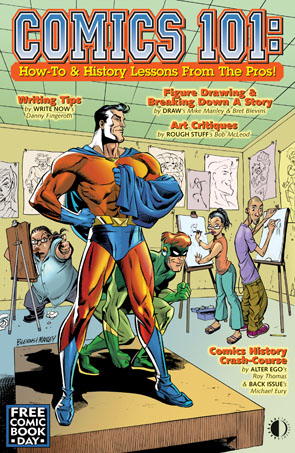
Review: Comics 101: How-To & History Lessons from the Pros!

A short primer that places cultural context at the heart of comics creation

Most manuals and ‘how-to’ books about making comics fall into three categories: the first assumes no drawing skill on the reader’s part and instructs accordingly; the second assumes some skill in drawing (and using software) and offers technical direction about combining or adding to those skills; the third, and most useful, considers comics holistically, as a cultural medium.

Comics 101 falls into this third category. Really an extended magazine, produced by by TwoMorrows Publishing for Free Comic Book Day 2007, Comics 101... features articles by editors from several of its specialist comics-related magazines.

So firstly, there are articles on figure drawing and story layout, which cut to the point very smartly.


I also found Bob McLeod’s critique of a Fantastic Four layout fascinating and full of direct advice (‘It’s always better to design your elements using diagonals, rather than horizontals and verticals’ and ‘center the figures in the panel, then design the backgrounds around them’ and so on).


The article on writing is fairly general, but offers some good points on etiquette in dealing with publishers. But the two longest articles are potted histories of comics. The first article explains the roots of the comics medium up to the 1970s and the evolution of the super-hero genre.
The second article concerns the modern era of comics, the advent of commercialisation and direct sales and the innovation of indie comics and the graphic novel.


What marks Comics 101 out as unusual is its insistence on basic skills, patient development of ideas and awareness of the historical and cultural context in which comics are created and consumed.

Of course it cannot be as in-depth as Scott McCloud's Making Comics, at just 30-odd pages, but as a freebie it is excellent value in every way.

15 January, 2009

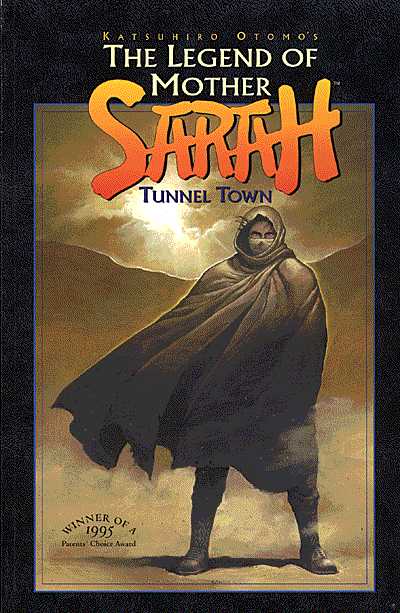
Review: The Legend of Mother Sarah

Sarah’s search for her children leads to a startling discovery

I’m not well read in Manga (though I loved Ranma ½ and Oh My Goddess!), but even I know of Katsuhiro Otomo, the creator of Akira. So it was with interest that I read The Legend of Mother Sarah: Tunnel Town, one of Otomo’s lesser known works.

Mother Sarah is set in a distant future, in which warfare has left the Earth irradiated and uninhabitable. A radical group, Epoch, has managed to tilt the planet’s axis and expose new land for settlement.

The titular Sarah scours the scattered settlements looking for the children she was separated from during the outbreak of civil war for control over the new Earth.


While the questing plot is familiar within the genre, Mother Sarah explores some unusual themes. For example, I can think of few comics that deal with motherhood or feature women in middle age (except as supporting characters).

Apart from delivering the occasional ass-kicking, Sarah’s special ‘power’ is her ability to offer motherly guidance to the two young people she befriends in Tunnel Town, a mining colony run by the fascistic government and operated by slaves/prisoners of war.

Sarah is a catalytic character; the actual protagonist is a young soldier in the totalitarian regime, who longs to prove himself to his seniors, and the young girl who looks up to him.


The squalor of war is more well-trodden ground in comics, but Sarah herself, while vaguely sympathetic to the Epoch faction and opposed to the fascists, is unconcerned with the political claims of either. Seldom are the Epoch freedom fighters portrayed in a more flattering light than the greedy fascists.

Sarah eschews explicit moral or political stances for a more general sense of compassion for all war’s victims.

Although the storytelling of Mother Sarah is simple and direct, which would seem to make it ideal for younger readers, it is super violent; everybody gets shot in the face. (There is also one panel of porn in the middle of the book, which is random.)

The artwork took a while for me to get used to. It is black and white and very low key, which allows for high detail, but could wash out the compositions. I was surprised to find the result was a flawlessly smooth read; the eye was not arrested every couple of panels or even pages, but was allowed to 'scroll' through the story easily. This is the first time I have really paid close attention to the 'cinematic' effect of Manga that Scott McCloud speaks about in Understanding Comics.

Mother Sarah may not be a classic, but it is highly original in its conception and immaculate in its production.

09 January, 2009

Review: Peculia

Will Peculia ever find the frightful diversion her heart desires?

I love the bargain bins and sale shelves of bookshops. In this hyper-marketed age, any opportunity for randomness and chance is worth taking and the second hand shop is abounds with both.


Among the remaindered, crease-covered and unwanted I have found many rare treasures: Sin City: The Hard Goodbye, The Land of Nod Rock-a-Bye Book, tomes about Japanese Crests and digital illustration.


So it is fitting that a recent sifting turned up Richard Sala’s Peculia, which itself is a kind of reverie on serendipity. Sala is a comics artist and an illustrator who has specialised in what I would describe as a kind of gothic surrealism. He has published several graphic novels and worked on the Lemony Snicket film a couple of years ago.


Peculia concerns the eponymous heroine's barefoot, nocturnal meanderings in the lands around her gothic mansion. Although she meets the hideous, perverse and ghoulish during her adventures and missteps, they offer no trouble beyond her capable manservant.

Peculia's adventures have the same strange dream logic as Jim Woodring's Frank stories. The stories are elliptical and allegorical in style, without being clearly about anything. Whether menacing or erotic in tone, they firmly emphasise the atmospheric, stylised artwork.

Sala's style has become fairly recognisable in recent years (although Sala was clearly ahead of the trend); it has traces of German Expressionism and woodcuts, it is illustrative and expressive, rather than graphic, with a soft, hand-drawn feel. However, Sala is also a really excellent draughtsman, whose style and content are inseperable.

04 December, 2008

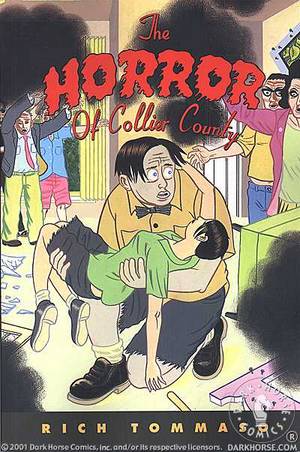
Review: The Horror of Collier County

A good try, but this tale of suburban paranoia lacks meat (cadaverous or otherwise).

It is unfair, perhaps, to judge a book by what it is not, rather than what it is. This is the fine line that criticism treads. No Platonic ideal of what a Graphic Novel should be guides the reader, but expectations are always there. The physical object itself creates them, even without reading it, by its titles, titles, pictures and graphic style, its volume, the feel of its pages.

Rich Tomasso’s The Horror of Collier County starts promisingly, when the car of a young, single mother is beset by alligators. This sets the stage for a mild mystery, in which the young woman investigates the strange hostility of her mother’s neighbourhood, with the help of a friendly local. In fact the Strangeness of Collier County might be a better title for the comic.

To my mind The Horror of Collier Country (its very title suggestive of HP Lovecraft and John Collier) promised a surreal, post-Buffy world, stalked by demons, zombies, unnameable evils, perhaps. Although Tomasso does a good job of building a creepy atmosphere, there is little payoff for it; the undead, unearthly or incomprehensible make few appearances.

This is a brief story in a minor key, which is fine. Unfortunately the relationships between the characters lack depth and drama and with the weird elements being so low-key, the story feels a bit flat. I wanted more background.

Having said all that, Tomasso has a sweet graphic style - redolent of Dan Clowes and Jay Stephens - both economical and free. Notwithstanding a few narrative glitches, The Horror is paced and designed well, with the occasional splash page making good impact. Bearing in mind that The Horror was Tomasso’s first graphic novel, the quality of the artwork alone would encourage me to read more of his work.

10 October, 2008

Review: The Mutant Chronicles


Tom Jane must save a dreary future Earth from zombies with pointy arms. Hmm.

Films based on computer games are largely poor (viz Street Fighter, Super Mario Brothers, Dead Or Alive). Sometimes the games themselves are poor, but more often they are simply unsuited to adaptation. Genre films demand strong narratives (and hence strong characters), which are not the strengths of the fighting games and shoot-em-ups that more often make it to the cinema.

The Mutant Chronicles (or MuChron, as I prefer to call it), starts from the further disadvantage of being based on a tabletop wargame of the same name.

Set in the 28th century, MuChron concerns the recruitment, by Brother Samuel (Ron Perlman) of cynical soldier Mitch Hunter (Tom Jane) to lead a mission to destroy an ancient alien machine which turns the dead from Earth’s interminable wars into mutant zombies.

Despite a labourious exposition of its dreary steampunk setting, in which four corporations based on racial stereotypes duke it out for control of the Earth’s natural resources, the whys and wherefores of this world are considered irrelevant to the movie (which, after all is about killing zombies).

Nothing could be further from the truth however. Science Fiction set in distant futures, pasts or worlds demands greater explication of its workings, than does fiction set in a familiar contemporary world which we know intuitively. It is never explained why, for example, 700 years into the future, culture, technology and warfare have stalled in the 1940s, except for the steam-powered spaceships.

Despite the absurdity of its premise and its claim to be an Action-Adventure film, MuChron is a particularly grave affair, high in grime and stoicism, short on round-house kicks, impaling, explosions and witty one-liners (not even an anachronistic knees-up ‘round the old Joanna). Indeed it is pretty short on zombies too.

However, if MuChron lacks in plentiful zombies, it compensates by having Brother Samuel bang on about how Faith is great and how Mitch ought to have some, to which Mitch replies: ‘I’m not paid to have Faith. I’m paid to fuck shit up.’ Quite.

To paraphrase another review I once read, the distasteful result is a feeling of having been robbed of precious time and a lingering and humiliating sense of having misunderstood a not very funny joke.

15 August, 2008

Review: Mac Raboy's Flash Gordon Vol. 1

A rocket- fuelled adventure into the history of comics.

Most of my reviews go well over 100 words, but I'm really going to keep to it this time. Starting now.

No wait... now.

Mac Raboy took over from his hero Alex Raymond drawing Flash Gordon for King Features Syndicate, from 1948 until his death in 1967. This volume collects Raboy's Sunday comics strips from 1948-1953.

The artwork is great on some of the strips, with great panel design and illustration. Raboy is justifiably renowned for his bold lighting effects, which give a lot of punch to the strips.

But two things particularly struck me about these Flash Gordon strips. The first was the short-form storytelling.

Although one of Flash's adventures to outlandish alien planets could be as long as a modern comic book - albeit spread out over a couple of months - these newspaper strips, with their mini-adventures and cliffhanger endings, feel like a completely different genre to modern comics.

The narrative skips a lot of action, giving the impression of fast-forwarding through the story. Lots of momentum, to be sure, but not much coherence, which must have worked just fine for weekly readers.

The second big feature was the dominance of captions and the absence of speech balloons, any emanatae or sound effects. Dialogue is in reported speech and frequently summarised in the captions.

I wonder why Raboy chose not to use speech balloons, which had been long established. From a graphical perspective it allows for nice, clean compositions, but it creates quite a static, airless effect.

Modern comics have few or short captions, direct speech between characters and lots of 'sound', which creates a lively, direct feeling to the narrative and puts the reader in the scene.

Raboy's Flash Gordon is exactly the opposite and while it is fascinating from a historical perspective, it really feels its age. This first volume, collects the earliest strips, so it might be interesting to see how the strip changed over the years.

Okay, was that one hundred words? No?

01 August, 2008

Review: Essential Silver Surfer Vol. 1

A powerful extra- terrestrial being, exiled on Earth, struggles to gain acceptance from human society.

The Silver Surfer could easily be subtitled 'be careful what you wish for, you might just get it' and Norrin Radd (the alien who becomes the Silver Surfer) is a truly tragic character, brought low by his own hubris.

Radd lives on Zenn-La, a Huxley-esque, alien world, dominated by leisure. Radd dreams of adventure and with the arrival of Galactus - a cosmic being who dines on planets - Radd gets his chance.

Galactus spares Zenn-La in exchange for Radd's services as herald, and transforms Radd into the space-worthy Silver Surfer so that he can search the galaxy for uninhabited planets to satisfy his hunger.

When the Surfer runs low on planets and refuses to offer up Earth as a tasty treat, Galactus imprisons him on Earth, unable to return to Zenn-La or Shalla-Bal.

The script in this volume can be a bit hammy - Stan Lee drops lots of 'thous' and 'thees' and his ubiquitous aliteration - but John Buscema's earthy, muscular artwork more than makes up for it.
If only the colour pages of most of todays comics looked half as good as Buscema's black and white ones, which are dynamic and lyrical.

One cannot help but wonder at the incredible talent that Marvel had at its disposal in its early days. Buscema would have been a star in his own right, if he hadn't been in the company of the even greater talents of Steve Ditko and Jack Kirby.

The Silver Surfer is a decidedly downbeat hero. The reality of roughing it with the primitive Earthlings - who generally shun, shoot and loathe him by turns - is a far cry from Radd's dreams of adventure and he is constantly assailed by people wishing to use his awesome cosmic power for their own gain.

In fact, many episodes leave the Surfer alone and bereft, dreaming of the life and love he left behind, far away across the galaxy.

25 July, 2008

Review: The Dark Knight

Batman defers retirement when a maniac with a sense of the sublime begins to wreak holy terror on Gotham City.

Rarely has an action movie full of preposterous characters, feats and action been so heavy hearted. In The Dark Knight, Batman is not the Caped Crusader, but a lonely outsider, burdened by his sense of responsibility and the moral limbo in which that places him.

In fact, while British director Christopher Nolan's first outing, Batman Begins, was gritty, Dark Knight brings an emotional realism and intensity seldom seen in any film, let alone an action movie.

The characters's struggles with the nature of social order and individual freedom, morality, duty and justice, would not be out of place in the Art House.

The film plays with themes and images of duality throughout. Batman has several 'others', such as Gotham's white knight, hotshot DA Harvey Dent, Jim Gordon, Batman's liaison in the civilian world, and of course the chaotic Joker.

At the heart of Dark Knight are compelling turns from Heath Ledger and Aaron Eckhart, in a cast full of great actors. Ledger's Joker is frighteningly alien and veteran character actor Eckhart, gives a nuanced performance as Dent. And while Christian Bale and Gary Oldman shine, as usual, Maggie Gyllenhaal and Morgan Freeman are underused.

The action scenes and sequences in
Dark Knight are markedly improved from Batman Begins. Kinetic, muscular and unmarred by CGI tells, a couple of the set pieces are astonishing. While the film is largely well-paced, at two and a half hours it can hardly avoid a few longeurs.

The most amazing feat is that a Batman film full of references to the War on Terror™ - extraordinary rendition, meticulously-planned acts of terrorism by a villain with a 'higher calling', video footage of terrorist hostages and a hero who must sometimes play a villain etc. - could be made in America, in its current hysterical mood.

It does Nolan credit that he has made a film that goes straight to the essence of the Batman mythos and the American mythos.

18 July, 2008

Review: Tank Girl Visions of Booga 1 & 2

Tank Girl and her boyfriend Booga evade the law and the mafia, as they search for Booga's long lost little brother.

I never felt that Tank Girl had a lot of legs in it. The greater part of its energy lay not in its scatalogical humour, but in Jamie Hewlett's sparky illustration.

However, Alan Martin has revitalised Tank Girl, with this muted, slightly melancholy road story. Tank Girl starts the story having lost her tank as a stake in a bet; and what/who is Tank Girl without a tank.
Of course, there are still plenty of trouser jokes - and a couple of random, short, silly back-up pieces - and dumb references, but it much moodier (at least two issues in) than previous incarnations.


The muddy covers, by Ashley Wood, say a lot for the atmosphere of Visions, as does Christian Krank's beautiful colouring. Rufus Dayglo (who did layouts for The Gifting) assumes main art duties from Wood and does a nice job, with a cartoony, but restrained style.

An intriguing beginning.

02 July, 2008

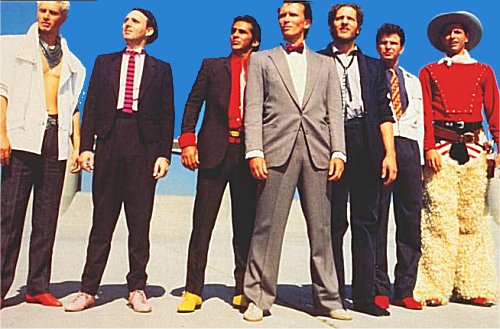
Review: The Adventures of Buckaroo Banzai Across the 8th Dimension

Earth is caught in the middle of an alien civil war and only Buckaroo Banzai can save the day.


When astrophysicist/ neuroscientist/ samurai/ rockstar Buckaroo Banzai (Peter Weller) succeeds in trans-dimensional travel, a band of fascist aliens (Red Lectroids) exiled on Earth (led by John Lithgow) steal his device to return to the 8th dimension. The good aliens (Black Lectroids) threaten to nuke the Earth to prevent the Reds coming back.

In the course of saving the day, Buckaroo is joined by his fellow band members/ crime fighters, the Hong Kong Cavaliers, and suicidal girlfriend Ellen Barkin.

I
love pulp Science Fiction and had heard that this film was a cult classic, but I was hugely disappointed. Droll names, zany complications and references to Thomas Pynchon do not make up for the fact that the storyline is fairly muddled and the film is poorly paced.

In his review of the film, David Kehr of the Chicago Reader gets it spot on when he says 'the film gives you the mildly annoying sensation of being left out of a not very good private joke.'

18 June, 2008

Review: Charles Burns 'Black Hole'

A sexually-transmitted disease divides a group of high school teenagers, with horrible consequences.

Black Hole follows the comings-of-age of two teenagers - Keith, a shy boy, and Chris, a pretty, popular girl - in a small, Oregon town in the 1970s. Both are complicated stories of social and sexual anxiety, set against the freewheeling sex-and-drugs hippy culture of the 1960s.

Black Hole touches on many cultural turns in modern American life: the end of the '60s and its idealism, the advent of fear about sex and HIV, the shakeup of social norms in a fracturing, destructured society, the extreme alienation of youth from itself - such as that which has produced the Columbine killings and their like - and from adult society.

Burns's stunning graphical style - reminiscent of woodblock printing - is not an obvious choice for the subject matter and all the more powerful and strange for it.

Compelling, sad, compassionate, novelistic in scope and depth, Black Hole does not reveal its mysteries readily and will bear (even demand) repeated reading.